
announcements
We have a bunch of new subscribers who I met last Wednesday when I presented to the California Department of Education’s System of Support for Expanded Learning gathering (say that 10 times fast!). Welcome!
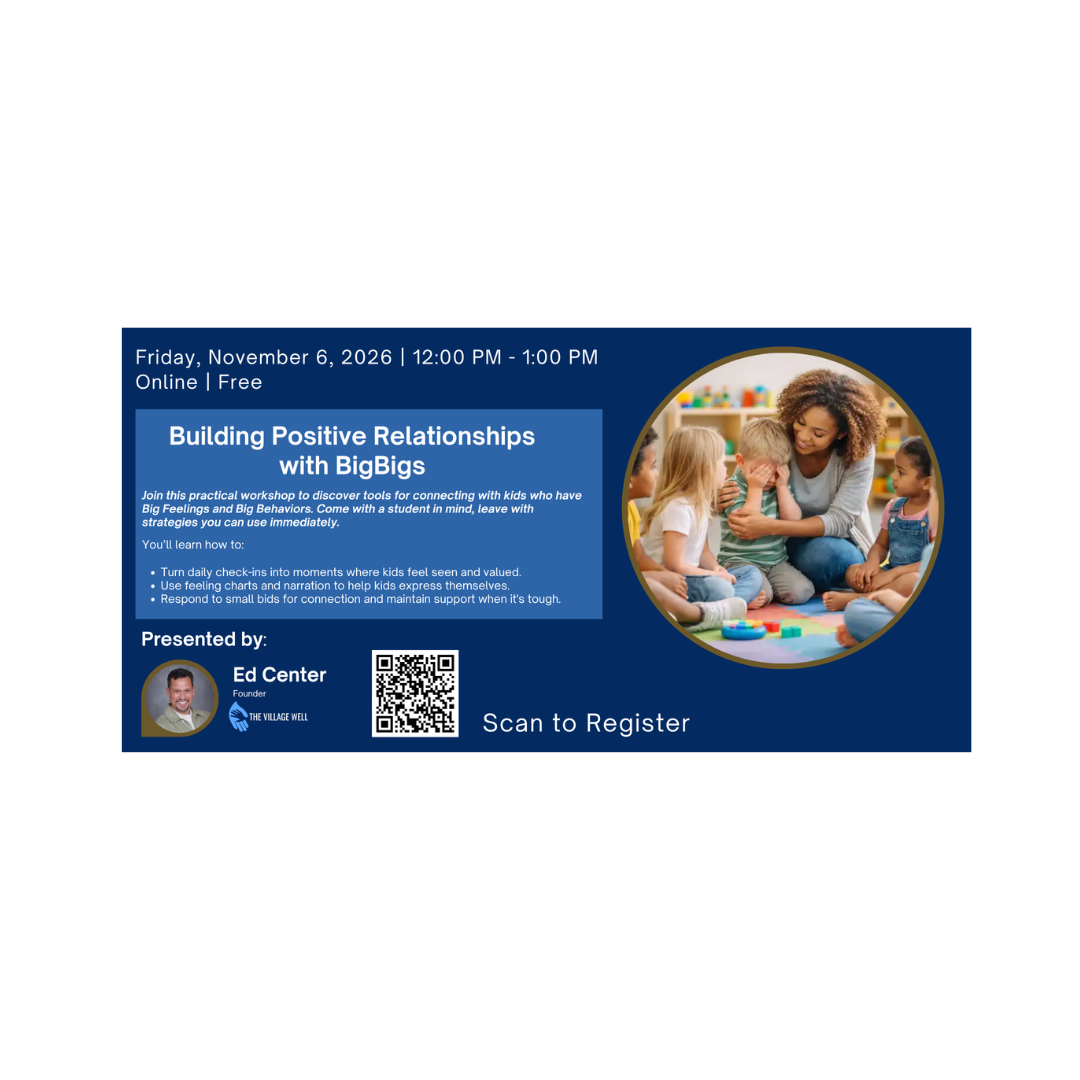
Building Positive Relationships with BigBigs
Friday, November 6 | 12:00 PM to 1:00 PM PST
Free Online Workshop
Some kids make it easy to connect. Others push you away, test your patience, and need you to keep showing up.
“BigBig” is my nickname for kids with Big Feelings and Big Behaviors. I was one of these kids. When kids trust that you see them, care about them, and are on their side, they’re more willing to accept support and try hard things.
In this interactive workshop, we’ll explore six practical tools for building connection and tackling the everyday obstacles educators and youth development workers face. Come with a student in mind. Leave with strategies you can use that afternoon.
You’ll learn how to:
Turn everyday check-ins into moments that help kids feel seen and valued.
Use feeling charts to help kids communicate what’s happening inside.
Find opportunities for Special Time, even during a busy program day.
Notice and respond to kids’ small bids for connection through Serve and Return.
Use Permission and Narration to help kids recognize their feelings while giving them a voice.
Build connection through appropriate touch that respects everyone’s boundaries and choices.
Keep investing in relationships when connection feels difficult—and choose practical next steps for a child in your program.
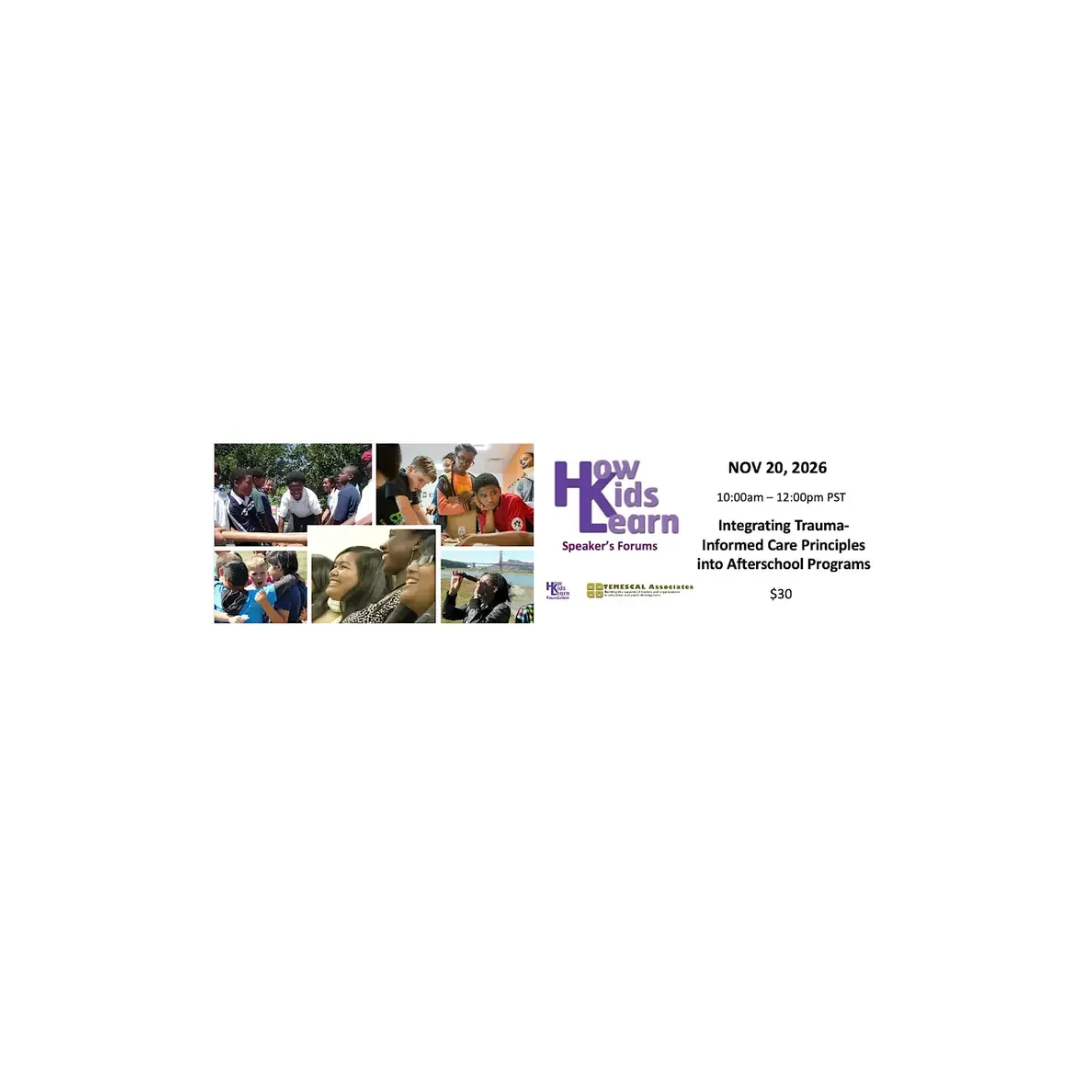
Integrating Trauma- Informed Care Principles into Afterschool Programs
Friday, November 20 | 10:00 AM to 12:00 PM PST
Online Workshop
FEE: There is a $30.00 (+$3.85 ticket fee) to register. We will send you a link to access the webinar closer to the event. All attendees will receive a subsequent email after the webinar with additional resources and a link to the webinar recording to share with colleagues.
Many of the children we serve in afterschool programs have experienced individual or collective trauma. According to the Substance Abuse and Mental Health Services Administration (SAMHSA), over two-thirds of children report experiencing at least one traumatic event by age 16, at least 1 in 7 children experience abuse or neglect annually in the U.S. each day, 14 youth die from homicide, and more than 1,300 are treated for violence-related injuries.
Expanded learning programs are well positioned to support students impacted by trauma because they provide safe spaces, opportunities for students to explore their talents and build new skills, help to increase school engagement, provide academic support, cultivate social and emotional development, and much more.
WHO SHOULD ATTEND: Expanded learning leaders, afterschool and summer program directors and staff, district expanded learning administrators, nonprofit program directors, managers and site supervisors, professional development leaders, and technical assistance providers.
the heart of the matter
It’s the morning after election day. I hope that you are breathing easy.
Your vote was a critical democratic action, but it was only a start. As educators and parents, we must remember that democracy requires an educated citizenry. Our responsibility is to help children understand history, distinguish fact from opinion, think critically, consider different perspectives, and recognize manipulation. We must support them to advocate for their beliefs, even when they differ from ours, through calls, emails, joining electoral campaigns, and protests. That responsibility continues between elections.
This is the second of a four-part series on the skills of building relationships with students. I excerpted the content for this series from the book I’m writing on how to support kids with disabilities in expanded learning programs.
olkit: the check-in, special time, and serve and return.
These are simple, practical ways to communicate powerful messages to every child:
I see you. You matter. I’m glad you’re here.
Learn and practice these tools. In a short time, you’ll figure out which ones work best for you and your students. These tools are key for parents as well!
The Check-In
A check-in is a moment of genuine connection before jumping into directions, correction, or instruction. It might be as simple as making eye contact, greeting a child by name, asking how their soccer game went, or noticing that they got a haircut.
A good check-in says, “I see you as a person, not just as a student.”
Check-ins fall into two categories: standard and short.
Standard Check-ins
Standard check-ins are usually held at the beginning of the program day. Students sit in a circle and take turns answering a question. Here are some approachable questions that elicit quality sharing:
Young Elementary — TK–2nd grade
What’s one thing that made you smile or laugh today?
If your mood were weather, what would it be: sunny, cloudy, rainy, stormy, or something else?
What’s one thing you’re excited about today?
What’s something you did today that you’re proud of?
Older Elementary & Middle School — 3rd–8th grade
What was the best part of your day so far? What was the hardest part?
On a scale of 1–10, how much energy do you have right now? What would help you bring it up or calm it down?
What’s something you’re looking forward to this week?
What’s one thing you need right now: energy, quiet, food, movement, help, space, connection, or something else?
High School
What’s taking up the most space in your brain right now?
What’s one high and one low from your day?
What’s something you’re looking forward to - or dreading - this week?
What’s something that happened this week that you’re still thinking about?
What do you need from this group today: distraction, connection, support, space, laughter, advice, or something else?
Students should take their time answering a check-in, so I recommend smaller groups of 5-10 kids. Allow students to pass if they want to. Your goal isn't to extract personal information; it's to create a predictable opportunity to share and to communicate.
Successful check-ins require the group to create and respect emotional safety. Put downs, mean laughter, and rudeness will ruin the experience. Review community expectations before check-ins, including ground rules around respect.
Short Check-Ins
Short check-ins are great for bigger groups or impromptu connections. Here are some examples:
The Thumb Dial
Great for all ages
Stand in a circle with your kids. Say, “Okay, I want to know how everyone is doing today! Show me with your thumbs. Are you thumbs up? Thumbs down? Or somewhere in the middle? All answers are welcome.”
Look around the circle and make eye contact with each student who is comfortable with eye contact. Give nonverbal validation through smiles and eye contact. Choose some students for verbal validation and follow-up questions.
“Karina, I see your thumb is to the side.”
“Chris, is your thumb down? Did you have a hard day at school? Okay, I’m going to find you later and you can tell me more if you want to, okay?”
“Joel, you have a big thumbs up. It looks like you are excited and ready to go.”
Through this activity, you’ve accomplished several key things:
You’ve shown your students that you care.
You’ve validated that all feelings are okay.
You’ve collected key data on their moods and readiness. Students who gave a thumbs up may be ready to be pushed further in their learning and growth. Students with a thumbs down probably need some extra patience and TLC.
You can use the Thumb Dial anywhere, at any time, with no special equipment.
Multiple Choice Greeting
Great for TK–4th grade
This is one of my favorites! This short check-in requires some setup, but it’s well worth it for the fun you’ll create.
It’s way easier to understand this activity by watching it, so do that here:
The Fly-By
Good for all ages
The Fly-By is an informal short check-in when you have a moment with a student. You ask a question or follow up on something you know.
For example:
“Are you still playing soccer? How’s the season going? Do you like your coach?”
“You told me you were fighting with your sister. How are things going now?”
“This is your first year at this school, right? How is it going? Have you made new friends?”
Special Time
Special Time happens when an educator spends time with a student one-on-one or in a small group. You engage with students with more play and less formality, while of course maintaining professionalism and boundaries.
Examples of Special Time could include:
Playing four square
Playing chess or Uno
Talking with one student as you transition from one place to another
Telling “dad jokes” to a small group of kids

In Special Time, you aren’t teaching or directing. You are just having fun with the kids. Everyone lets their guard down a little.
This gives a super dose of belonging to the kids you spend time with. You are showing rather than saying, “Right now spending quality time with you is the most important thing to me.”
It’s challenging to implement Special Time because you have multiple responsibilities. How can you give your focus to one kid when you have a large group? The key is to find time when multiple staff are present, such as recess or lunch, so you can find five or ten minutes to give your full focus to one child or a small group.
Special Time creates space for magical moments: an ultra-competitive match of Connect Four, belly laughter that feels like an ab workout, time reading Dragons in a Bag when you both feel transported into the plot.
During Special Time you are focused on connection and letting your guard down. This is a time to be less directive and more engaged. Remember that you are not a peer. Be childlike, not childish.
Keep your professional boundaries. Don’t gossip or allow put-downs of other students or staff. Share about yourself, but keep it appropriate. The magic of the youth development educator is enjoying play while remembering that you are the adult.
Serve and Return
Throughout the day, your students will send you small signals to get your attention or affection. Using a tennis metaphor, we call these signals “serves.”
Here are some examples:
While walking down the hallway, a child takes your hand.
A student whines, “My tummy hurts.”
A student asks if you’ve seen a viral meme.
A student asks for your help, and when you tell them you can’t right now, they exaggerate a sigh and roll their eyes.
In each case, the child wants you to return the serve with an action or comment that validates their need.
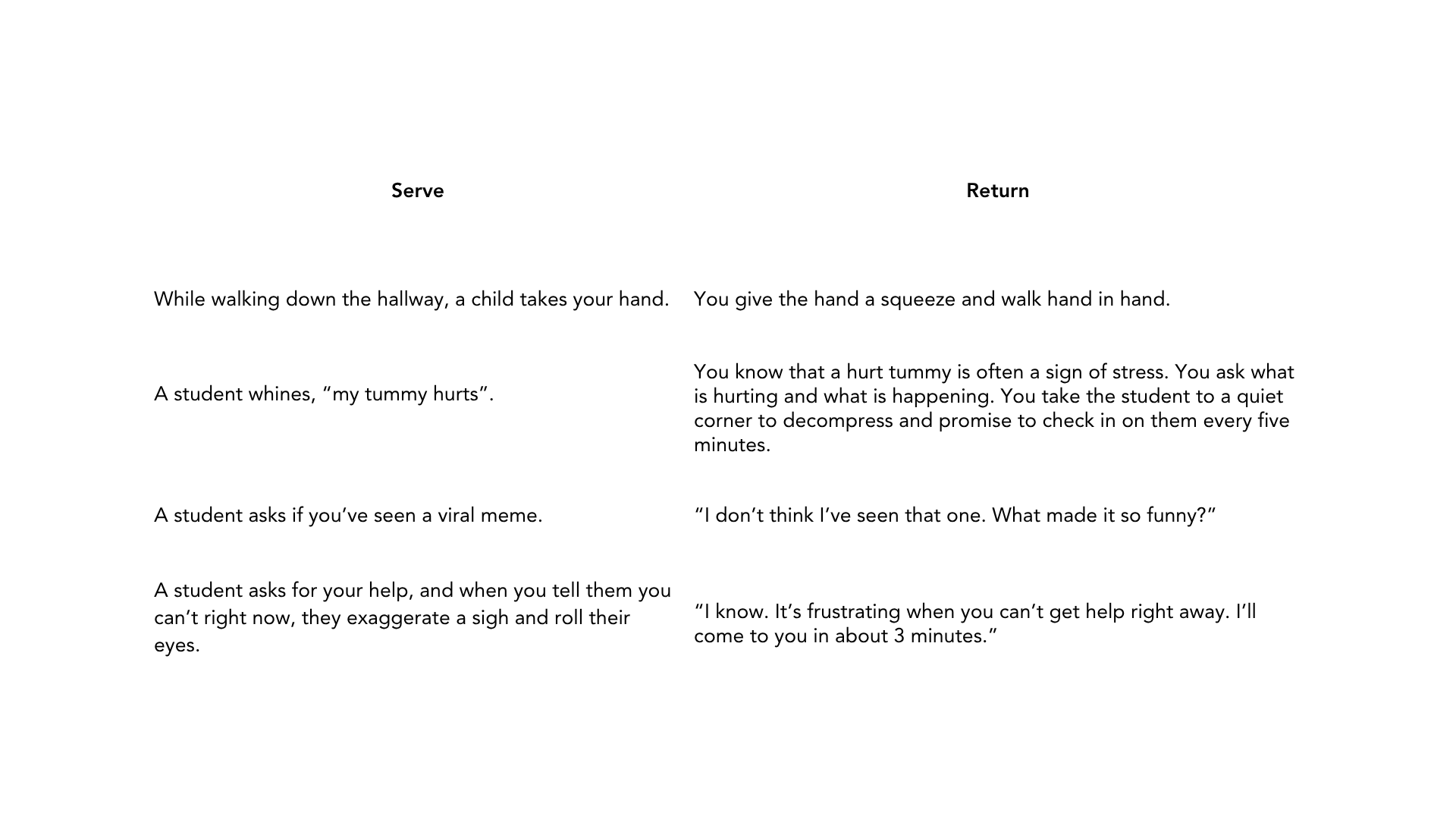
With the statement, “It’s frustrating when you can’t get help right away,” you acknowledge the need, while giving no energy to the eye roll. A few minutes later, you can check in with the student, build that connection, and also teach appropriate ways to get your attention or build their ability to wait for it.
In your busy program, it’s impossible for you to return every serve. But you should make an effort to return most of them. Acknowledging the serve and committing to return later still counts as a return! For example, “Jamila, I see you have something important to tell me. I can’t get to you now, but I want to hear it soon. Make sure you remember it! Do you have it locked in your brain? Okay, I’ll come find you in 5 minutes.”
A major hindrance to returning serves is that supercomputer in your pocket. Smartphones are hindering our ability to read our children’s cues. Keep your mobile phone stored away from you during program hours!
Stay tuned for the rest of the Relationship Building Series:
November 18 - More Relationship Building Tools
December 2 - When Connection is Extra Challenging
my regular rant against screen time
I’ll be monitoring how our new U.S. Congress moves to regulate A.I. in the immediate future. The prevailing positions today are handwringing or complete denial of threats such as chatbots encouraging suicide, job obsolescence, and the end of humanity. We should get moving on these problems. This opinion piece is dated but excellent. It’s written by an 18-year old who makes clear and urgent arguments about why AI regulation is essential to her future.
If you are interested in doing more to promote regulation in service of our children, Common Sense Media and Public Citizen are great places to start.
we’re obsessed with
Sweatpants season. I was in Davis, CA for a few days last week and it was colder than expected. I stopped in Target and bought this matching sweat outfit. I haven’t taken it off since! It’s so comfy, and I get so many compliments on it. Except for my husband, who says I’m giving yoga studio owner vibes. But I’m going back to Target to buy this in multiple colors and I’ll be living in this ensemble all winter.

Speaking of cold weather, the NY Times released a list of 11 one-pot chicken recipes. My family eats a lot of chicken. And broccoli. So I’ll start with Skillet Thighs with Broccoli and Orzo. Then I’ll move on to Chicken and Rice with Ginger and Cumin.
Don’t subscribe to the Times? Email me and I’ll send you the recipe.

where we’ve been

At October’s CDE Expanded Learning SSEL and STEAM In-Person Meeting, Ed led a workshop titled Systems of Inclusion for Kids with Disabilities in Expanded Learning at the CDE Expanded Learning SSEL and STEAM meeting. He shared actionable tools to help expanded learning staff better support neurodivergent youth and students with complex needs.
Trainer and facilitator extraordinaire Cory Wechsler joined the team for this workshop!
A special thanks to our key partners and collaborators who helped bring this event together, including Olivia Garcia, Melea Meyer, and Julie Sesser from ASAPconnect, alongside Michael Funk, Jen Taylor, and Lindsey Castillo from the California Department of Education (CDE) Expanded Learning Division.
Book a workshop for your school or organization
Bring The Village Well to your school or organization. We provide powerful, interactive and fun workshops for parents and/or staff. Learn more

As a child with undiagnosed ADHD, Ed Center experienced firsthand what it’s like to navigate big feelings and behavioral challenges. He founded The Village Well to ensure families and educators have the practical tools and support kids with disabilities and mental health needs deserve. Whether you’re looking to build a more inclusive program or support a child at home, our team is here to help. Schedule a consultation with us today to get started!
FOLLOW THE VILLAGE WELL ON: